
Pawar Multispecialty Hospital offers one-stop treatment for all type of health concerns. We have multiple options to manage the Vericose veins including radiofrequency ablation, foam sclerotherapy, stripping, and laser.
Expanded, dilated veins in the legs and feet give rise to Vericose veins. The Vericose veins are twisted and blue or dark purple. The situation occurs when the values in the blood vessels do not function properly. Women are most likely to develop the disorder during pregnancy.
Spider veins are the twisting of vessels similar to that of the spider mesh and hence named. They are red-purple usually form in the legs, chest, or face region.
- Greater Saphenous Vericose Veins
- Lesser Saphenous Vericose Veins
- Branch Type Vericose Veins
- Genital Area Vericose Veins
- Reticular Type or Web Type (spider veins) Vericose Veins
Following are the causes for developing Vericose veins:
- Increased age
- Pregnancy
- Genetic makeup
- Excessive body weight
- Longtime standing or sitting
Following are the signs that indicate Vericose veins.
- Veins grow dark purple or blue
- Twisting and bulging of blood vessels
- Pain and burden in legs
- Constant throbbing and burning sensation
- Increased pain after sitting or long time standing
- Itching
- Blood discharge through dilated veins
- Redness of the skin
Laser ablation system for keyhole treatment of Vericose veins (EVLA)
The process involves the insertion of the laser into the saphenous vein, which then warms the blood to a very high temperature. Then by creating a steam bubble, doctor destroys and closes off the Vericose vein.
Radiofrequency ablation
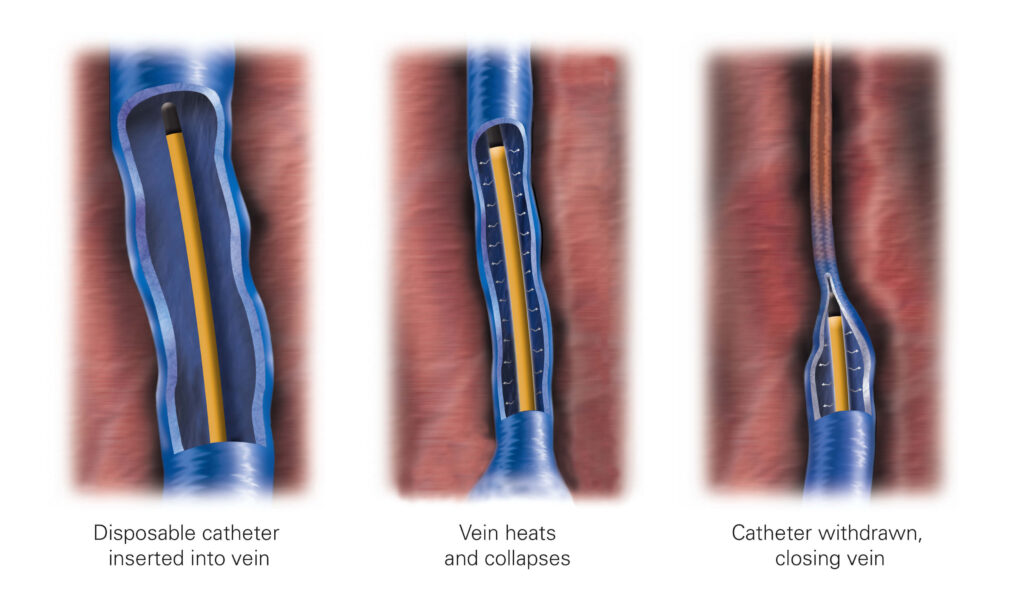
It is a less invasive method that uses radiofrequency heat energy to destroy the affected vein wall and seals the vein. In this, the surgeon delivers radiofrequency energy through a catheter by making a tiny hole in the vein. It takes a short recovery time.
- Drink lots of water.
- Take the prescribed medicines
- Wear comfortable clothes like long pants, shorts or a skirt.
- Bring a person to your procedure for your care.
- Avoid extended sitting or standing at the one place.
- Avoid strenuous activities.
- Do not lift heavy things at least for two weeks.
- Perform regular walking.
- Use compression stockings and wear them for three days after the procedure.
- Try to get up and move around every hour.