Hernia is a bulging of an organ or tissue through an abnormal opening A hiatus hernia is a situation that occurs when the section of the stomach, and in some cases, the reduction part of the esophagus, pushes through the hiatus in the diaphragm into the chest cavity. When a hernia has appeared, it isn’t very likely to solve alone. Moreover, not all hernias are suitable for laparoscopic repair. An untreated hernia may also put an excessive burden on nearby tissues.
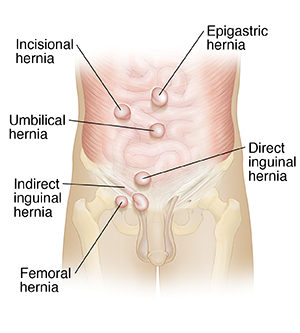
- An inguinal hernia: It happens in inside the Groin when a bladder/ intestine open via the intestinal wall/ inguinal canal through lower abdomen into the groin. It is common in men.
- A femoral hernia:It occurs in pregnant and obese women. It happens when bowel enters into the canal leading the femoral artery into the upper thigh or fatty tissue pushed through into the groin at inner top thigh.
- Obturator Hernia: This kind of a hernia happens in women who have had multiple pregnancies and lost vital weight by the time.
- An umbilical hernia: It usually appears in newborn babies or the women who are obese and have many children.
- An epigastric hernia: It seems to infants because of abdominal wall weakness.
- A Spigeleian hernia:It happened when intestine pushed via abdomen by stomach muscle below the belly button.
- An incisional hernia: It occurs to the people who had gone through abdominal surgery before or who were inactive after the surgery.
- HIATUS Hernia: A hiatal hernia occurs when the upper part of your stomach bulges through the large muscle separating your abdomen and chest. In a hiatal hernia, the stomach pushes up through that opening and into your chest.
Following factor causes a hernia:
- Age, prolonged coughing, sneezing
- Injury to organs
- Pressure on abdomen
- Constipation, heavy weight lifting
We offer a variety of treatments for colorectal disease, and they are as follows:
- Bulging raises while standing and decreases while lying down
- Pain and stress in the stomach
- Bleeding at the time of bowel action
For diagnostic purpose following ways are used:
- Primary physical examination
- X-ray technology
- Endoscopy
We treat a hernia with Open or Laparoscopic technique. We prefer laparoscopic therapies at our hospital. Apart from this, we use some other methods, but Mesh Repair is the most standard method to cure a hernia.
- Open Hernia Surgery: It is the typical method to treat the hernia patients. It requires spinal numbness. It is useful for reducible Hernia /obstructed Hernia.
- Laparoscopic Hernia Surgery: The technique has many benefits over the open hernia repair. It holds lower infection risk, long-term outcomes, and requires shorter recovery time.
- 3D Hernia Mesh Repair: It is done by using BARD mesh. The method is more popular because of the following features or advantages:
- The technique uses Three Dimensional, curved, sealed edge mesh and patient can go home on the same day or within 24 hours
- It is the minimally invasive technique with fast recovery.
- Relatively less painful with minor cuts
Pre-Surgery Instructions
- Perform necessary tests before proceeding to operation
- Do not consume a heavy meal
- Get proper rest
- Use comfy clothes
Post-Surgery Instructions
- Drink plenty of water only consultation after doctor.
- Do not eat junk foods
- Take prescribed medicines only
- Walk along after few hours of surgery
- Follow your surgeon’s instructions for medications, diet, and wound care.
- Keep the incision clean and dry – change dressings as advised.
- Eat light, fiber-rich foods (fruits, vegetables, whole grains) to avoid constipation.
- Drink plenty of water to keep digestion smooth.
- Walk slowly every day – light movement improves blood flow and reduces the risk of clots.
- Support your surgical area while coughing/sneezing (use a small pillow or hand).
- Take prescribed medicines on time for pain relief and infection prevention.
- Attend all follow-up appointments to ensure proper healing.
- Don’t lift heavy weights or do strenuous activity for at least 4–6 weeks.
- Don’t strain during bowel movements – use a stool softener/laxative if required.
- Don’t drive until your doctor clears you.
- Don’t smoke or drink alcohol – they slow down recovery and increase risks.
- Don’t skip rest – your body needs time to heal.
- Don’t apply any ointment or powder on the wound unless prescribed.
- Don’t ignore warning signs like severe abdominal pain, swelling, fever, pus discharge, or difficulty in passing urine/stools.